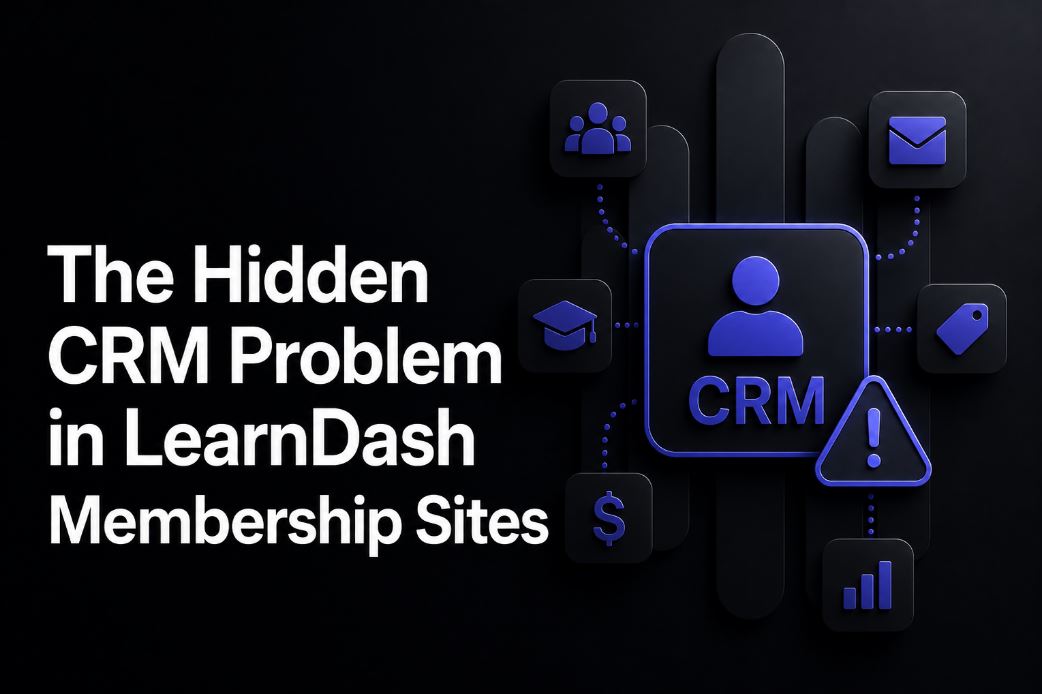
One of the biggest operational problems I see inside membership ecosystems today is over-dependence on the CRM, and organizations often don’t even realize how dependent they’ve become until they try to change something.
- Maybe they want to migrate CRMs.
- Maybe they’ve outgrown the platform.
- Maybe automations became too complex.
- Maybe reporting stopped making sense.
- Maybe the API calls are becoming unreliable.
And all of a sudden, the organization realizes the entire platform is wired around the CRM. Probably 50% of my clients are in that pain point of some form of transition, and that’s usually the stage where the business starts feeling operationally trapped.
Everything Becomes Dependent on the CRM
What happens over time is that businesses slowly move more and more operational functionality into the CRM layer. At first it’s simple:
- email automations
- tagging
- basic segmentation
- sales funnels
But then eventually:
- billing lives there
- access control lives there
- member permissions live there
- progression triggers live there
- community automations live there
- onboarding logic lives there
And now the CRM is no longer supporting the platform, the CRM is the platform. That’s where the fragility starts compounding.

The Multi-Tiered Complexity Problem
Once multiple systems become interconnected, troubleshooting becomes incredibly difficult, and you end up with these multi-tiered complexities where you don’t know:
- did Zapier fail?
- did Salesforce fail?
- did the API fail?
- is it a communication issue?
- is it a load issue?
- is it a data issue?
That’s one of the biggest hidden operational costs inside CRM-dependent ecosystems, because the organization ends up spending more time diagnosing infrastructure than improving the member experience.
Every automation becomes another potential failure point, every integration becomes another dependency layer, and every new initiative increases operational risk, until eventually teams become afraid to touch the system at all.
The Problem With CRM-Centered Architecture
The reality is that most organizations architect the ecosystem backwards. They build the membership platform around the CRM instead of building the CRM around the platform, and there’s a huge difference there.
One of the opportunities is to center up your functionality inside of the platform. While everything is fully integrated with the CRM, it doesn’t have to be dependent on the CRM, whether it’s billing or even tag management, and that’s a very different architectural philosophy.
The CRM should absolutely receive the data, and the CRM should still:
- handle communications
- manage marketing automations
- store customer intelligence
- support campaigns
But the operational functionality of the platform should still exist independently.
The Goal Is Platform Independence
The goal is that if the billing system and everything is inside of it, you literally could unplug the CRM to some degree and this would still operate, and that changes everything.
Because now changing CRMs becomes a transition instead of a rebuild. You’re not rebuilding infrastructure anymore, you’re simply moving CRM data from one place to another, and that dramatically decreases operational risk while also giving the business flexibility as it grows.
Because the reality is that most businesses eventually outgrow some piece of their technology stack, and that’s normal. What becomes dangerous is when changing one system threatens the stability of the entire ecosystem.
The API Dependency Problem
One of the most overlooked problems inside CRM-centered ecosystems is API dependency. Most organizations assume APIs are stable because they work most of the time, but once critical operations become dependent on external communication layers, reliability becomes probabilistic.
Now access management depends on:
- successful API calls
- successful webhooks
- successful automation triggers
- successful communication between platforms
And if any part of that chain fails, the member experience breaks. Maybe a member loses access incorrectly, maybe onboarding sequences fail, maybe progression automations stop firing, or maybe purchases don’t sync properly, and oftentimes nobody notices immediately. The issue only becomes visible after support tickets start piling up.
CRM Dependency Also Creates Reporting Fragmentation
Another hidden issue is fragmented reporting. Part of the data lives inside WordPress, part lives inside the CRM, part lives inside automation platforms, and part lives inside community plugins, so nobody has a cohesive operational picture anymore.
And that’s one of the downsides to traditional WordPress ecosystems: you’ve got to go into WooCommerce to see commerce, into LearnDash to see progression, and into the CRM to see customer behavior. Everything becomes fragmented, that fragmentation creates blind spots, and blind spots create bad operational decisions.
The Better Approach
The better approach is platform-centered architecture, where the platform becomes the operational core and the CRM becomes a connected intelligence and communication layer. That distinction matters enormously at scale, because now:
- billing can survive CRM changes
- member access remains stable
- progression systems remain intact
- reporting becomes cleaner
- diagnostics become simpler
- maintenance becomes easier
And most importantly, the organization regains operational flexibility.
The Future Is Operational Architecture
The reality is that modern membership ecosystems are no longer just websites, they’re operational systems. They’re onboarding systems, behavior systems, progression systems, communication systems, and commerce systems, and when those systems become overly dependent on one external platform, fragility compounds very quickly.
That’s why architecture matters so much, not just integrations, not just automations. Architecture.
If you’re looking for a LearnDash expert to help with your CRM issue, please contact me!